Designers (24)
Close
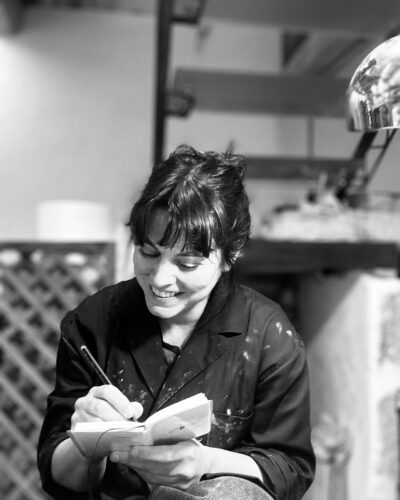
There is a tactile stillness in Laura Pasquino’s work. An elemental quiet that invites touch before interpretation. Clay, in her hands, becomes breath, memory, and echo. Formed slowly and without spectacle, her pieces carry the weight of time, tension, and the negotiations between body and earth.
“I started shaping clay as a child,” she recalls. “Digging it from shallow seas, forming small pieces just for fun. But something stayed with me.” Years later, she returned to the material with intention. What began as instinct became devotion.

Maison Mouton Noir

Maison Mouton Noir
Clay, she says, is responsive. “It records everything. The weight of a hand, the slip of a tool. There’s no pretending. It answers back.” Her process is a dialogue rather than a plan, guided by listening and allowing the work to lead. She often develops several pieces at once, letting each find its own rhythm.
Repetition, for Pasquino, is not about duplication but exploration. “I come back to certain forms to see what else they can do. Each one shifts slightly. It’s how ideas grow.” The studio becomes a place of return, waiting, and gradual refinement.
Her days begin with movement, cycling to the studio to clear her mind. Once inside, she moves through a quiet routine: checking what has dried, trimming, firing, and preparing for the next stage. “When preparing for exhibitions, the kiln sets the pace. Loading, unloading, photographing, packing. It’s all part of making.”

Maison Mouton Noir

Maison Mouton Noir

Maison Mouton Noir
She embraces traces of the process — fingerprints, slips, slight shifts — as part of the work. “I don’t chase imperfection, but I don’t hide it either. What I’m drawn to is a quiet tension between control and chaos.”
Her influences range from layered stone and eroded earth to intangible sensations. “Lately, I’ve been interested in echoes. Half-remembered conversations, passing thoughts, sounds you feel more than hear.” Clay, for her, becomes a vessel for what resists being named.
Pasquino is comfortable working between disciplines. “Ceramics is no longer confined to craft or utility. It’s a space where emotional complexity can live.” She moves between sculpture and vessel, always anchored by intention and the experience her work offers.

Sacha Verberk & Janne Wellens

Sacha Verberk & Janne Wellens
A recent piece, Farmer’s Wife, marked a shift. Minimal yet monumental, it brought new questions about scale and form. “It felt like a breakthrough, and I’m still following where it leads.”
While she has taught occasionally, she is increasingly drawn to collaboration. “Working with others opens unexpected paths. It brings dialogue, and that’s where things shift.” Painting has also entered her practice, offering a different rhythm that complements her work with clay.
Whatever direction she explores, the heart of her practice remains the same: the insistence of touch and the slow shaping of something until it feels true. “There’s so much to uncover by continuing to work, quietly and steadily, with clay.”
Her work leaves an impression not through statement but through presence. A presence held in the weight of a form, in the surface shaped by hand, in the quiet that remains when the making is done.

Sacha Verberk & Janne Wellens