Designers (24)
Close
There is a particular kind of knowledge that cannot be hurried. The gardener who watches a tomato and knows, from colour and weight and the slight give beneath the thumb, that today is the day. The baker who reads the surface of a dough not by the clock but by feel. The cook who understands that a sauce is ready not when the timer sounds but when the kitchen begins to smell a certain way.
These are not techniques. They are forms of attention — slow, embodied, and entirely at odds with the world most of us inhabit.
Alice Waters was not, by her own account, trying to disrupt anything. She was trying to recover a pace. The memory she carried home from her student years in Paris was not simply of better ingredients — though the strawberries tasted of sun and the lettuces still held morning dew. It was of a different relationship to time. Markets visited daily, not weekly. Meals built around what had arrived that morning, not what was stored for convenience. Food that could not be rushed because its very quality depended on not being rushed. She carried that understanding home quietly, like a private instruction, and spent the next fifty years making the case that it mattered.
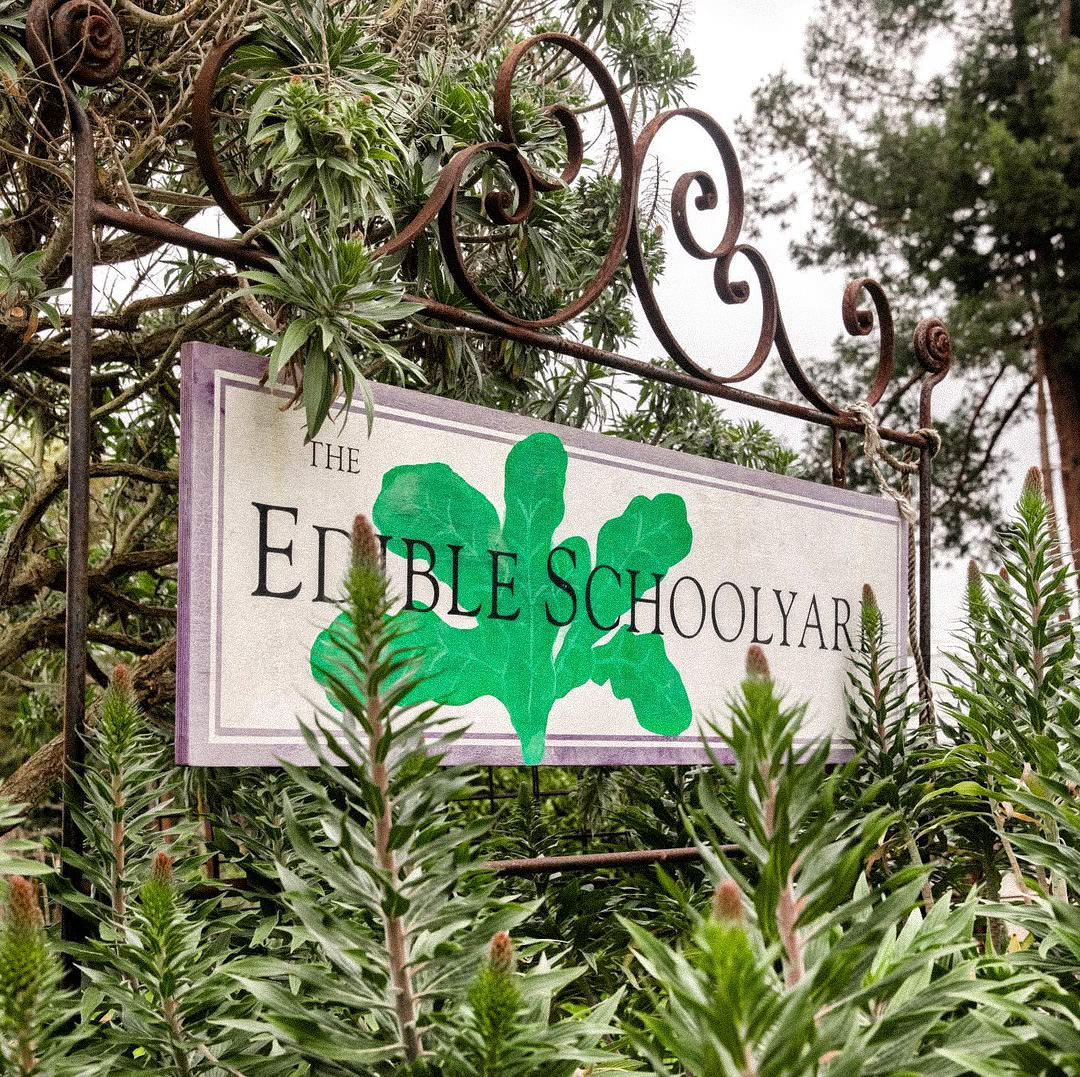
The Edible Schoolyard, where learning begins in the garden.
At Chez Panisse, the restaurant she opened in Berkeley in August 1971, the guiding principle was deceptively simple: cook only with what was ripe, fresh, and grown nearby. In practice, this meant accepting the constraints of the season — waiting for the ingredient to be ready rather than substituting, approximating, or importing something that merely resembled it. In the early 1970s, when most American kitchens ran on cans and convenience, this was more than culinary nostalgia. It was, in essence, an argument about time itself: that the best things could not be made faster, only better — and that better always required waiting.
She has spoken of wanting to serve people food that made them remember something true — not a dish, not a technique, but a pace. The particular quality of attention that arrives only when nothing is being rushed.
There is an intimacy to Waters’s cooking that is inseparable from its patience. A salad of garden lettuces dressed in shallot vinaigrette. A warm galette with fruit so fragrant it dissolves the concept of dessert. Her recipes are less about technique than about restraint: the discipline to let the ingredient speak, to resist the impulse to improve what is already complete. You taste the place. You taste the weather. You taste, above all, the time it was given.
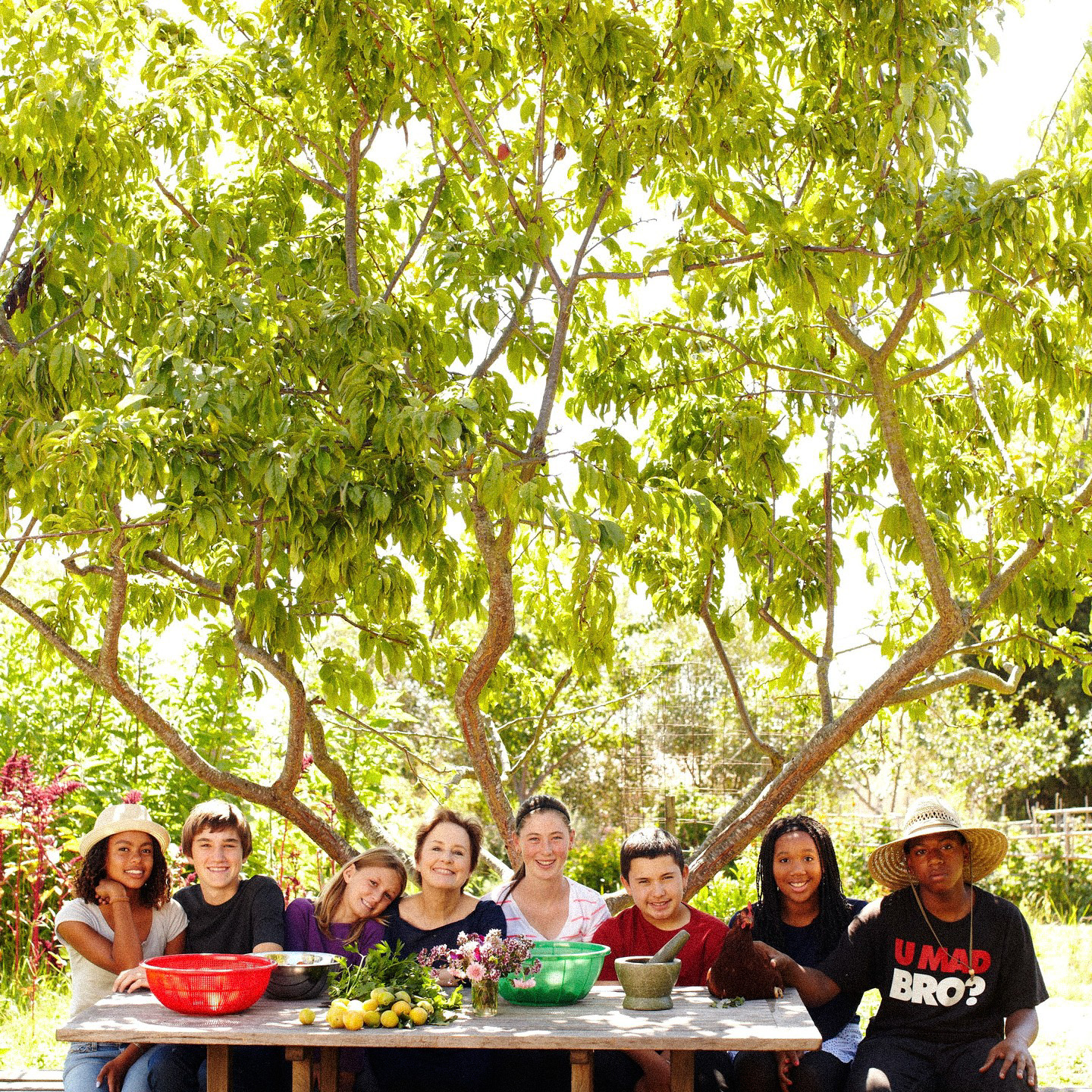
Alice Waters and students gathered in the garden, surrounded by harvest and shade.
That philosophy found its most visible expression beyond the restaurant in 1995, when Waters launched the Edible Schoolyard Project at a Martin Luther King Jr. Middle School, Berkeley — a programme that replaced a concrete lot with a working garden and integrated the growing, harvesting, and cooking of food into the school curriculum. A garden, after all, is the purest argument for patience: nothing can be rushed, nothing approximated, nothing delivered overnight. It was, characteristically, a quiet intervention with far-reaching implications — an argument, made in soil and seed, that taste is something learned young, and that how we feed children is inseparable from how we teach them to inhabit the world.
Through her writing and advocacy, she has insisted that how we eat is never separate from how we live. The choice of an ingredient is always, in some sense, a political act — but so is the choice of a pace. In a culture that has organised itself almost entirely around speed, convenience, and the elimination of waiting, to insist on slowness is not nostalgia. It is dissent.
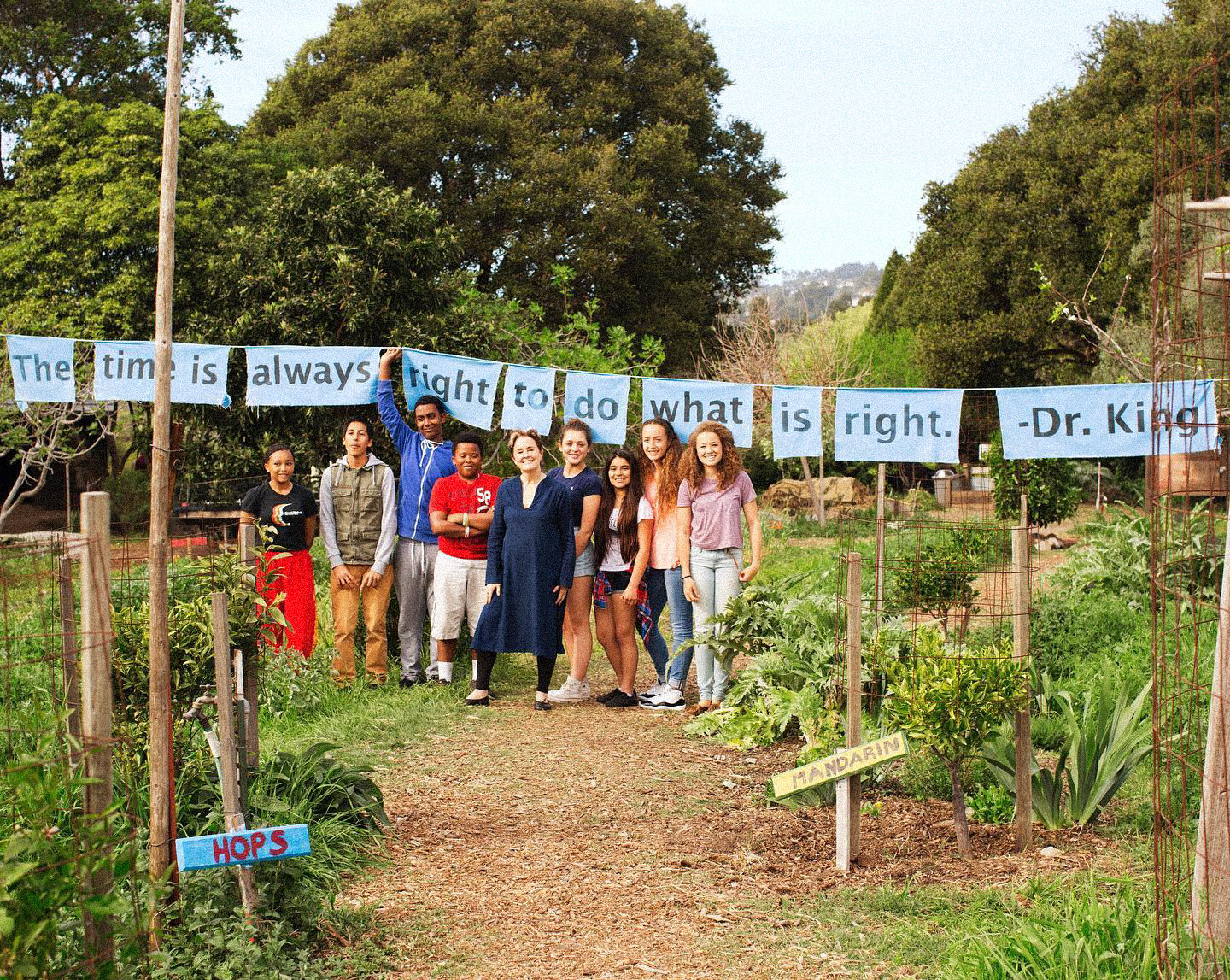
Students gathered beneath words of purpose.
And yet, for all her influence, she remains devoted to the intimate daily rituals of the table. A bowl of soup made with what is in season. Bread that requires time. Herbs picked at their peak. These are not inconveniences to be optimised away — they are the point. She has described taste not as a luxury but as a compass: a way back to something more grounded, more considered, more awake. A way, in other words, of learning to wait well.
In Waters’s world, knowing how to taste something is not a refinement. It is a form of knowing the world — one that requires, above all else, the willingness to slow down long enough to let the world be tasted. That, perhaps, is the quietest revolution of all.
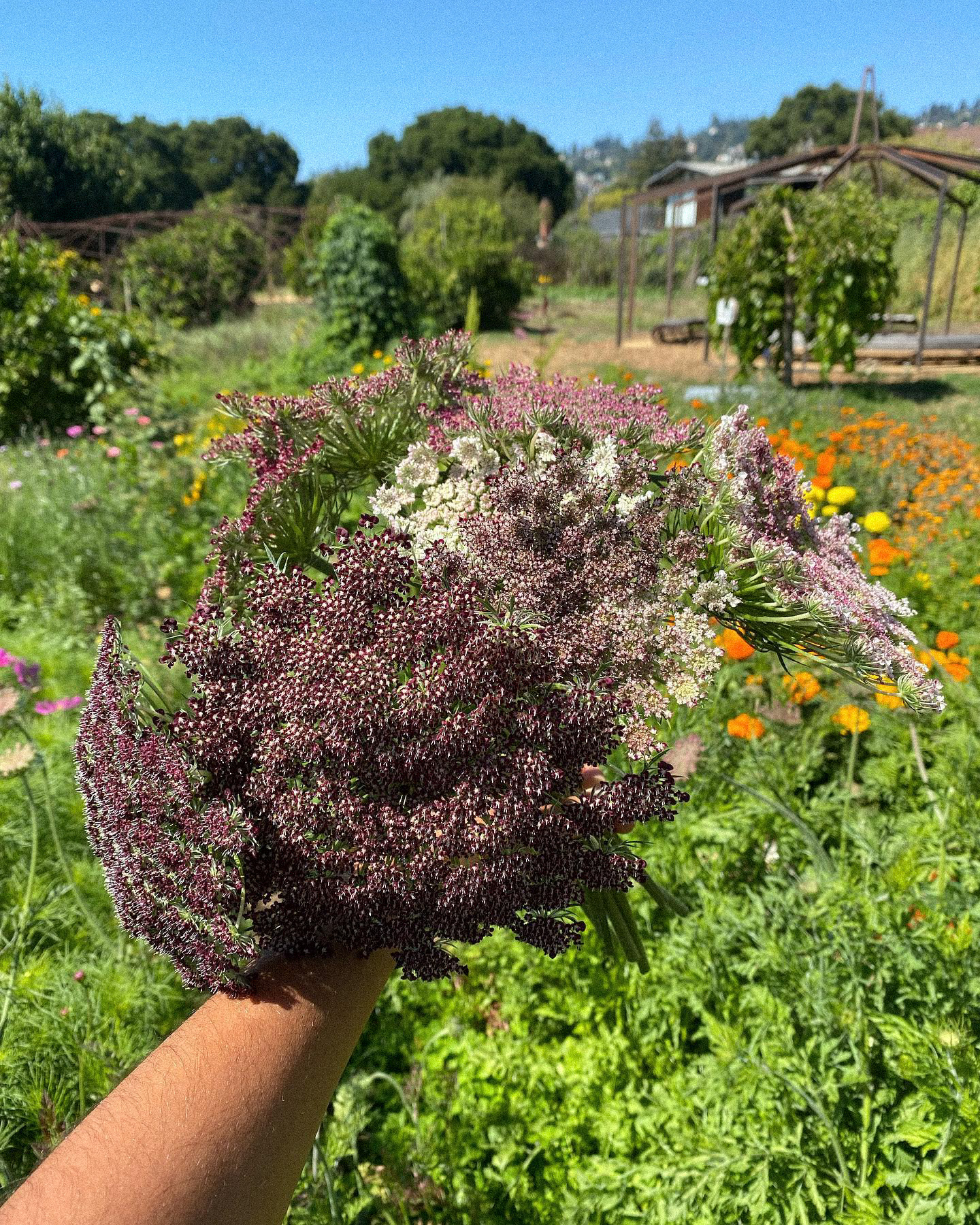
Fresh herbs gathered from the garden.
The galette that follows is offered in that spirit. It asks for good apples, a rested dough, and the willingness to wait — for the butter to chill, for the fruit to caramelise slowly, for the glaze to reduce in its own time. Adapted from the Chez Panisse repertoire, it is, in the end, less a recipe than an argument made edible.
Apple and Frangipane Galette
A Golden Ode to the Orchard
A galette, in the Chez Panisse tradition, is less about technique than about trust — in the season, in the ingredient, and in the understanding that some transformations cannot be hurried. This one is built for autumn.
The Dough
Yields enough for 2 open galettes or 1 covered tart.
2 cups unbleached all-purpose flour
1 teaspoon sugar
¼ teaspoon fine sea salt
12 tablespoons (1½ sticks) unsalted butter, chilled, cut into ½-inch cubes
7 tablespoons ice water
In a large bowl, combine the flour, sugar, and salt. Work in 4 tablespoons of the chilled butter with a pastry blender or your fingertips until the mixture resembles coarse sand. Add the remaining butter, cutting it in until the largest pieces are the size of plump peas. These larger pockets of butter are what make the dough shatteringly crisp, each one destined to melt into a whisper of flavour in the heat of the oven.
Drizzle the ice water over the dough in stages, tossing gently with your hands. Resist the urge to press or knead; the dough should look rough, with streaks of butter marbled through. Divide the dough in half, form each half into a disk, wrap tightly in plastic, and refrigerate for at least 30 minutes. This rest is not optional — it is what allows the dough to relax and develop structure.
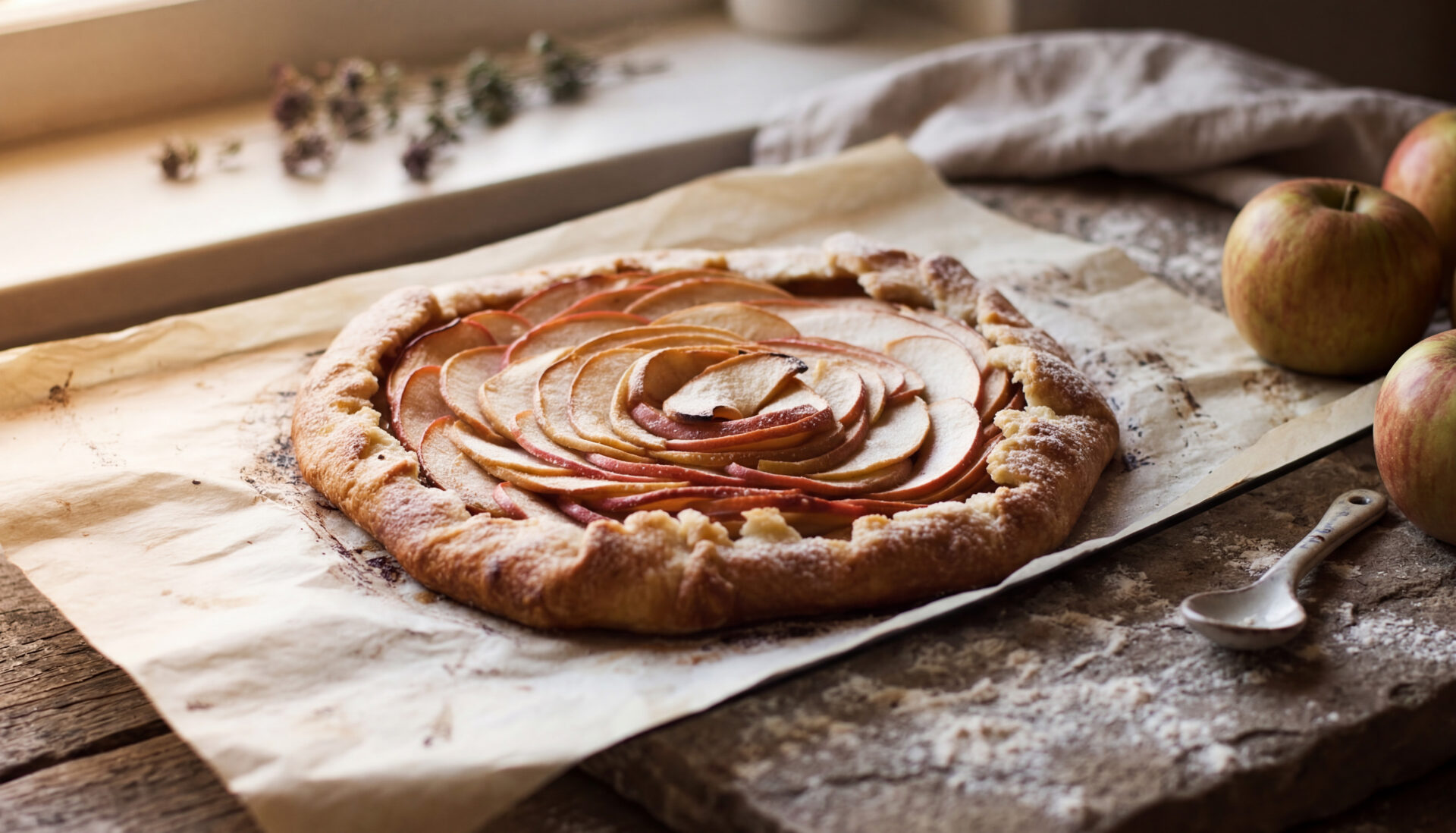
The galette. A gesture of patience, shaped by hand.
The Frangipane
Yields about ½ cup (enough for 2 galettes).
3 ounces (about ⅓ cup) almond paste
2 teaspoons sugar
2 tablespoons unsalted butter, softened
1 tablespoon all-purpose flour
1 large egg
Pinch of sea salt
In a small bowl, blend the almond paste and sugar until smooth, using the back of a spoon to break up any lumps. Add the softened butter and beat until light and fluffy. Fold in the flour, egg, and a pinch of salt, whisking until the frangipane is pale and airy. It should have the texture of a thick, spreadable cream. Refrigerate for at least 30 minutes. Like the dough, it improves with patience.
Assembly
10 ounces galette dough, rolled into a 14-inch circle
¼ cup frangipane (from the recipe above)
2 ½ pound of your favourite apples, quartered, peeled, and cored
2 tablespoons unsalted butter, melted
½ cup plus 5 tablespoons sugar, divided
Preheat your oven to 400°F (200°C), and if you have one, place a pizza stone on the centre rack. This will ensure a beautifully crisp bottom crust.
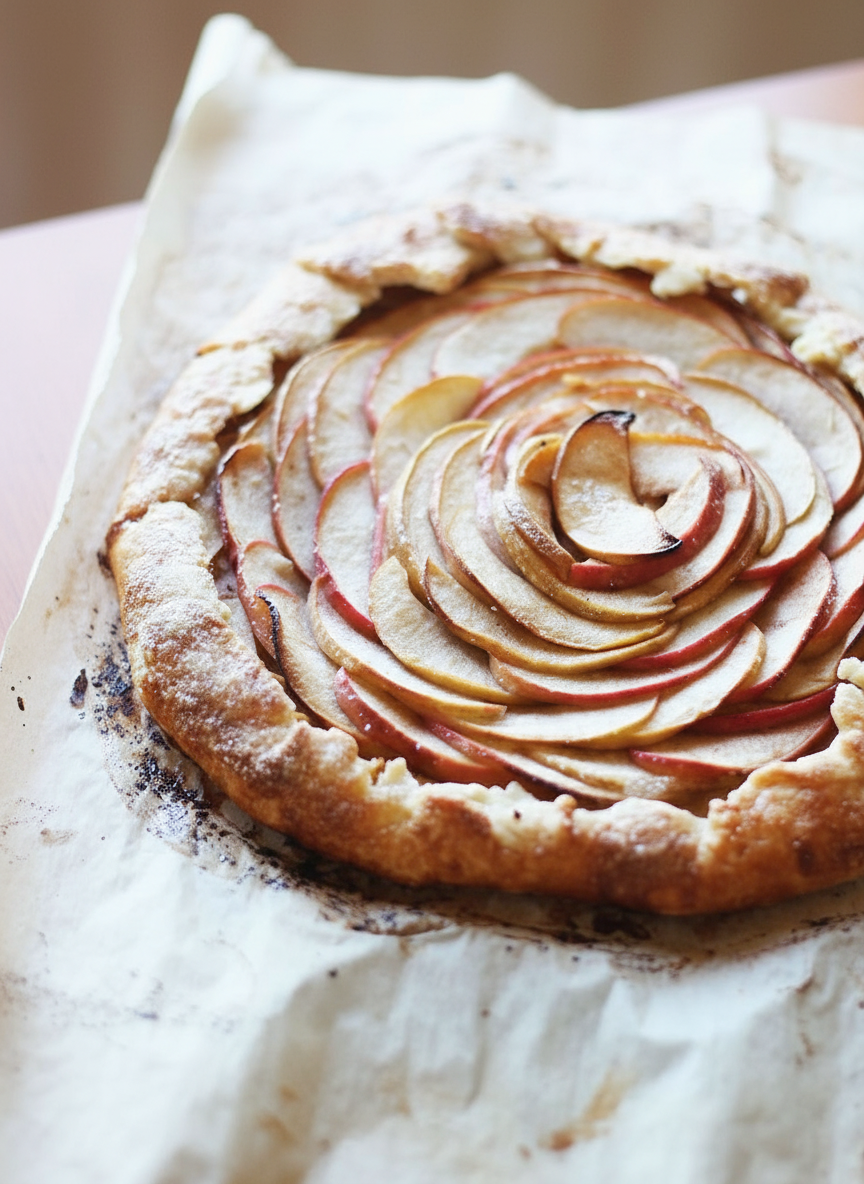
Retrieve the dough from the refrigerator and roll it into a 14-inch circle on a lightly floured surface. Transfer to a parchment-lined baking sheet and refrigerate for another 15 minutes.
Spread a thin, even layer of frangipane over the dough, leaving a 1-inch border. Slice the apples about ¼ inch thick, then arrange them in overlapping concentric circles, starting from the outer edge and spiralling inward. Fold the exposed edges of dough over the apples, pleating as you go to create a rustic, freeform border. Brush the apples and the pastry edge with melted butter, then sprinkle 2 tablespoons of sugar over the crust and another 3 tablespoons over the apples.
Bake for 45 to 50 minutes, rotating the galette halfway through, until the crust is deeply golden and the apples are tender, their edges curling slightly and tinged with caramel.
The Glaze
While the galette bakes, place the reserved apple peels and cores in a small saucepan with the remaining ½ cup sugar and just enough water to cover. Simmer for about 25 minutes until syrupy, then strain. Brush this apple glaze over the warm galette as soon as it emerges from the oven for a final, glistening touch.
To Serve
Allow the galette to cool on a wire rack for at least 15 minutes before slicing — the final act of patience the recipe asks of you. Serve warm, perhaps with a whisper of cream or a dusting of powdered sugar, though it needs little else to sing.
The Apples Matter
For this galette, seek out firm, fragrant apples that balance sweetness and acidity. Try Honeycrisp for their juiciness, Gravenstein for their tart edge, or Pink Lady for their floral notes. If you want something with a hint of spice, Cox’s Orange Pippin is a classic choice.
Wine Pairing
Serve with a lightly chilled glass of Côtes de Gascogne Moelleux, whose orchard fruit carries the brightness of autumn, or a Floc de Gascogne Blanc for a more rooted, seasonal expression. For something deeper, a small pour of aged Armagnac brings warmth and quiet spice, a final echo of almond and caramel.