Designers (24)
Close
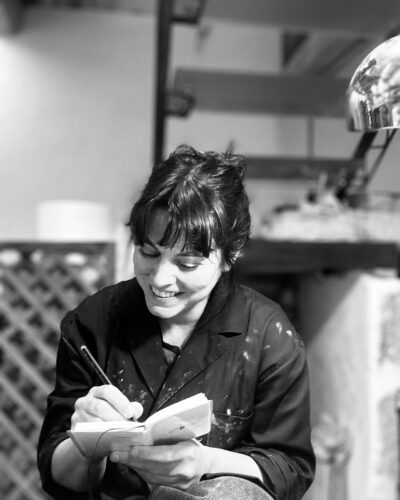
In a sunlit corner of her studio in Mexico City, Kara Rooney sits surrounded by fragments of her latest work: textiles dyed in muted earth tones, jagged ceramic sculptures, and sheets of paper covered in dense layers of charcoal rubbings. Her hands move with purpose, tracing the edges of a weaving, as she begins to unpack the intricate philosophy behind her artistic practice. Language, for Rooney, is not merely a tool for communication but the lifeblood of her creative endeavors.
“Language,” she begins, “is full of slippage.” Her voice is calm but resolute, a testament to years spent navigating the precarious terrain of linguistic instability. “We like to think of language as something fixed and permanent, but in reality, it’s incredibly malleable. The gaps in understanding, the misinterpretations, these are where my work lives. It’s about giving shape to those shadowy spaces.”


Cut Point No. 4

Rooney’s art is an intricate dance between poetics and visuals. “Poetry is expansive,” she explains. “It communicates in the same way images do: indirectly, open-endedly. When I create an installation, each object functions like a word, and the spaces between them are the pauses—the breaths that invite reflection. My aim is to build environments the way one constructs a sentence, thought by thought, piece by piece.”
Her latest body of work, Desire Line, exemplifies this philosophy. A layered meditation on memory, gentrification, and the power of movement, the series began with Rooney wandering the streets of Mexico City during the pandemic. As the city’s vibrant life came to a standstill, she started noticing the sheer number of historical buildings marked for demolition. “What happens to cultural memory,” she asks, “when the spaces that house that history disappear?”

Desire Line No 3, Col Condesa

Desire Line No 4, Santa Maria La Ribera

Desire Line No 2, La Roma
Her response was as tactile as it was conceptual. Rooney began taking charcoal rubbings of gates, windows, and moldings, preserving traces of these architectural elements before they were lost to gentrification. Back in her studio, these rubbings were transformed into abstract collages and eventually woven into textiles. Each piece, she explains, represents a different neighborhood of Mexico City, capturing the distinct aesthetic identity of its architecture. The textiles, paired with ceramic and stone sculptures, form an immersive “map” of the city’s threatened spaces. “This work is about archiving collective memory,” she says. “It’s a poetic critique of erasure and greed.”

Kara Rooney Archives
The Body, Word, and Image
For Rooney, the intersection of body, word, and image is both a challenge and a necessity. “It’s impossible for me to create without considering how a piece will move in the world,” she says. Working with physically demanding materials like stone, ceramic, and textiles, Rooney’s process is as much about endurance as it is about artistry. “The body is always the measure,” she adds. “Decisions about scale, weight, and form are dictated by the limits of my person. Sometimes the work feels like poetry, other times it’s just a stubborn lump of clay. It depends on the day.”
This physicality, combined with her deep engagement with language, creates work that resonates on multiple levels. “We live in a culture oversaturated with images paired with words,” she says. “But when you mix in the body, something different happens. Interpretation is no longer purely intellectual. The body brings emotion, chemistry, and sensation into the equation. That blending of the haptic, intellectual, and sentient is where the magic happens.”

Kara Rooney Archives

Kara Rooney Archives
Tracing the Threads of Identity
Rooney’s journey as an artist has been shaped by a rich tapestry of influences. A former art critic and editor for The Brooklyn Rail and other publications, she honed her analytical skills through years of writing about contemporary art. “That experience made me a better editor of my own work,” she notes. “It forced me to contextualize my practice within art history and broaden my perspective.”
Her move to Mexico City in 2014 marked a turning point. Captivated by the city’s vibrant energy and layered history, Rooney began exploring themes of architectural memory and cultural identity. “The city is embedded in my work,” she says. “Each neighborhood has its own personality, shaped by the era in which it was built. Translating those nuances into textiles and sculptures has been my way of archiving the city’s stories.”
Her influences are as varied as her materials: the feminist theories of Sylvia Federici, the experimental weavings of Lenore Tawney, the choreography of Pina Bausch, and the rich sculptural traditions of pre-Hispanic Mexico. “These voices and histories inform everything I do,” she says. “They’re the scaffolding on which my work is built.”

Kara Rooney Archives

Kara Rooney Archives
A Language of Memory
Despite the conceptual depth of her practice, Rooney remains humble about her impact. “I can’t predict how viewers will react to my work,” she says. “All I can do is provide an entry point for contemplation.” Yet, it’s clear that her art offers more than just a moment of reflection. Through her poetic approach to materials and her unflinching exploration of language’s blind spots, Kara Rooney invites us to consider the fragile nature of memory, identity, and the spaces we inhabit. In her hands, art becomes a language that transcends words, speaking directly to the heart of our shared human experience.